Beer Waffle 2511: “An Idiots Guide To Brewing a Beer”

It’s Friday 14th November 2025 and I’m not working today. I have lots that I need to do, but Storm Claudia (a Traitorous so & so), has kyboshed a lot of that. But one thing on my ‘to do’ list is to brew a beer for a forthcoming Chiverton Tap Homebrew Club competition. So, I’m brewing a “Schwarzbier”!

I thought I’d give a little rambling on how I go from a beer style to making something drinkable to a style. This won’t be textbook or even technically correct in lots of areas, hence this being the “Idiots (me) guide to brewing a beer”!

Everyone knows that beer is an alcoholic beverage. Some may also know that beers are made from 4 basic ingredients, the greatest quantity of which will be water, then grains (barley, wheat etc), hops and yeast. My brewing journey began when I wanted to understand how from those 4 ingredients you can make a session bitter, a light lager and a 10% ABV Stout. To explain how, here’s how I brewed my Schwarzbier and the steps I’ve gone through.

But if this seems “TLDR”, then the summary is:

  1. Add grains to hot(‘ish) water and make a sort of porridge
  2. Get rid of the porridge but drain all the (now sugary) liquid into a kettle
  3. Boil it (during which add hops) until sterilised, at least, and then cool it
  4. Pour into a sterilised container and add yeast
  5. Put a lid on and add a one-way valve so that it doesn’t explode under pressure
  6. Leave until it all dies down, then somehow make it fizzy’ish & drink it with friends

Before Brewday 1: Research…

The worthy winner of our last competition (Pete Hall, who brewed a superb 9.5% Belgian Tripel) gets to set the next competition & he chose for us to brew a Schwarzbier.

It turns out that the Beer Judge Certification Program (an organisation that trains and certifies individuals to judge beer, mead, and cider competitions) has a very long set of “Style Guidelines” that that they have developed to help ensure fair, consistent judging at competitions by applying standardised criteria to assess the quality and characteristics of entries. Dull, I know, but hey, ho!

It does however mean that anyone can find out what a Schwarzbier should look, taste and feel like to drink without even having tasted one! I managed to do some “research” last week at ISBFX and tried Amity Brewings “Festoon Black” 4.6% example.

According to the 2021 BJCP Style Guide for ‘8B. Schwarzbier’, it should be a “dark German lager that balances roasted yet smooth malt flavours with moderate hop bitterness. The lighter body, dryness, and lack of a harsh, burnt, or heavy aftertaste helps make this beer quite drinkable”. They then go on to give further detail about key characteristics of:

  • Appearance (e.g. colour and how clear)
  • Aroma (e.g. malty, bready, caramel, floral, spicy)
  • Flavour (e.g. the malts and hop balance, sweetness, bitterness)
  • Mouthfeel (e.g. syrupy or thin, fizzy or flat)

Before Brewday 2: And Design!

Having got to understand what I’m aiming to brew, I usually look online at lots of “recipes” for that style of beer, so that I get an understanding of the various ingredients that are common (essential, perhaps) for this style.

I then use an app called BeerSmith to build up my own version of that style. The app is very clever, having lots of formula built in to it as to how different ingredients and their additions in volume and time (I’ll explain as I go through the brewday, though) affect the final outcome.

Finally, with recipe determined, I order the ingredients online via specialists such as The Malt Miller, Get’erBrewed & Crossmyloof. When they arrive, I check the quantities and then store them appropriately (malts in a “mouse-proof, sealed container, yeasts in a fridge and hops in a freezer).

Brewday Cometh!

From reading lots of books (including the new brewers bible, John Palmer’s “How to Brew” which is now legally available free online), and evolving my own methods based on my available equipment and facilities, I have a laminated checklist and a brewday record sheet stuck to my Brewshed whiteboard. The process checklist evolves as I learn or my equipment changes more, usually through mistakes!

My checklists!

Either the night before or the morning of brewday, I’ll weigh out and store all the ingredients so that they are ‘to hand’. I then begin following my checklist, by setting up & filling the Hot Liquor Tank with water.
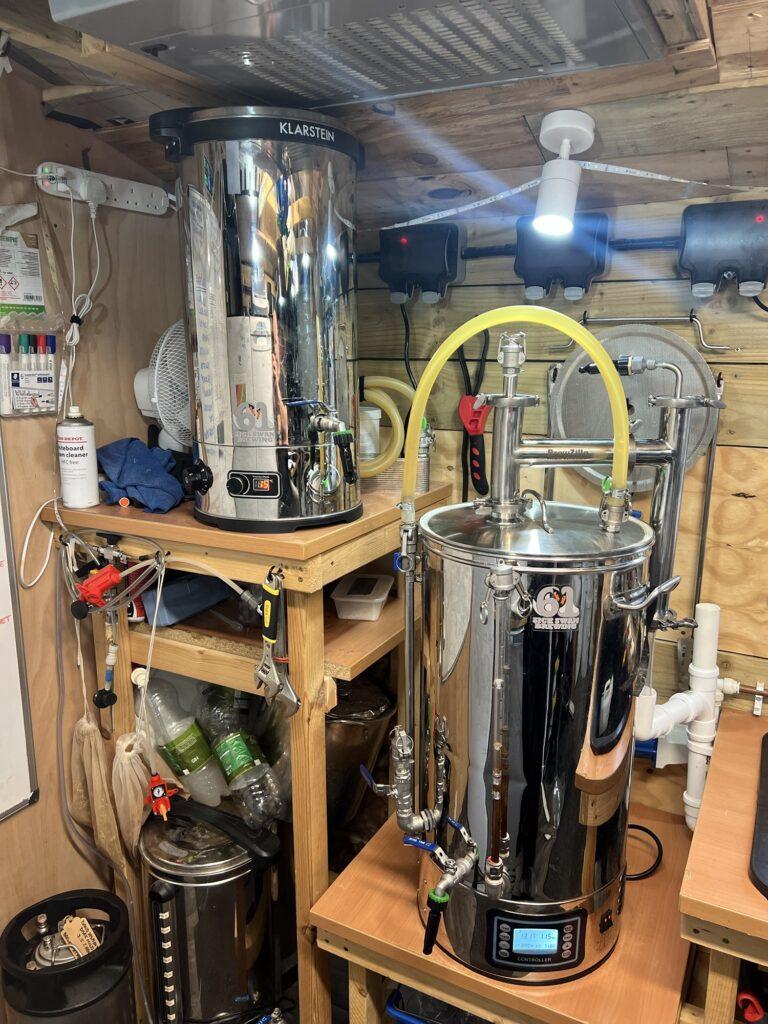
The HLT high up and my ‘All in One’ to the lower right

You’re going to find that Brewers use fancy words for stuff we have normal words for, so the “L – Liquor” in HLT means water. My “HLT” is basically a Tea Urn that has a thermostat on it and a tap.

I then fill up my “All In One” System. It’s a space saving single vessel system (we Brewers like the word “vessel”). Basically, in a real Brewery there will be a Mash Tun and a “Copper”. In my set-up there is one contraption that does a few things, where needed, without taking up space.

The Mash Tun is where you make the aforementioned “porridge”, and the Copper is another Brewery code word for a big kettle (shakes head at the attempts to make it sound magical).

The Mash Tun needs to hold enough grain (which some occasionally call ‘grist’ but it’s not really by this point as it needs to be smashed up a bit to get sugar to leach out) and enough hottish water to create the right quantity of sugary liquid known as “wort”, but it doesn’t get pronounced like that (Headline reads “Brewers in over-complicating simple things shocker”).

In my system, there is a big vertical tube that has a heater in the bottom of it. That’s the kettle bit. Then, there is a big tube ‘sleeve’ that fits inside the slightly bigger tube that has a circular, perforated bottom to it that’s a few inches above the heater.

This allows the water to pass through, without allowing most of the grain though because that would burn on the heater element and make the liquid taste rank. It also means that I can heat the sugary liquid (that is actually pronounced “wert”) back up to the temperature that it’s supposed to be.

Tube within a tube!

You want to get a decent quantity of fermentable sugars (the stuff the little yeasties like to eat) out of the grain so that its efficient use of the grain, but temperatures also change the activity of the different enzymes, and they pull sugar out of the grains that are fermentable or non-fermentable, starchy carbohydrate dextrin. Temps around 63-66°C help produce a drier, lighter body to the beer and 68-70°C give a fuller bodied and sweeter beer. Chemistry lesson over for now!

Even though I could and have brewed “SMASH” beers, where you only use a Single Malt And Single Hop, for the Schwarzbier I needed to use a mix of malts. The biggest proportion used are known as base malts and they do the heavy lifting in terms of giving up sugars but do also affect colour and flavour. The others are referred to as adjuncts, who’s job it is to tweak flavour, colour, head retention and mouthfeel. In this beer it needed to be dark so I used Chocolate Malt and Carafa that add lots of dark colours and flavours.

I stir in the (cold) 5Kg of grain to the 72°C hot water, which reduces the temperature to about 66°C, all the while making sure there are no dry lumps & clumps as that would be a waste of potential sugar.

“Mashing In”

Basically, I then kept the water washing through the grain at around 66-68°C for something around an hour (sometimes called “Vorlauf”). I went inside the house and played on the Xbox for a while. Eventually I’d rinsed all the decent sugars, colour and flavours out of the mash grains. So, I then raised the temperature of the wort up to 75°C, putting the handbrake on those enzymes and letting that finish off the final 10 minute rinse. I then lift that inside tube up and rest it so its above the big kettle and let all of the wort drain into the kettle.

The mash is still damp so I have to work out how much has been absorbed and then work out how much ‘new’ hot water to rinse through the mash to get the right volume of water needed for the next stage. Bear with me but I then do some sums (I do them in advance actually, but…)

Tube outside a tube!

I work out the total grain bill (e.g. 5Kg) and multiply it by about 4 to give me how many litres of water I need before I ‘strike’ the grain into it – 20L. Science and experience tells me I will lose about 800g of water per kilo of grain, so around 4L, leaving me with 16L, right? Now I also know I’m going to lose water in a few other ways later, so I need to account for that in advance of eventually drinking 19L of beer from my keg.

Once calculated (it’s not as difficult as I made that sound), I pull 12L of the 75°C hot water from the HLT and pour it through the mash as evenly as possible. This is known as Sparging (or lautering – don’t blame me!). Then after about 10 minutes, I have a kettle with around 28 litres of wort in it, and I put a complicated looking lid on it. Hurrah!

I hit the buttons on the kettle and get 3000 watts of electricity to heat 28L of water from 75°C up to a 100°C boil. This isn’t instant so I went and made a cup of tea and started cleaning stuff I won’t use again today. I also prep for the slightly busier part of the day that is coming up by making sure I have everything I’m going to use from here in clean, sanitised and “to hand”.

When my All-In-One “pings” to tell me we have a boil, then this is a step up in activity as this is where the hops get in on the act!

The Boil, with the tap feeding the condenser through the blue hose

What the feck are hops?! They’re the cone-shaped flowers of the female hop plant used to provide bitterness, flavour, and aroma, because they contain resins and oils that add a range of tastes and aromas (such as citrus, pine or floral) to a beer. However most of the time I cut the crappy bits out and use processed hops in pellet form (looks like rabbit food) as they are more efficient.

Hops also act as a natural preservative, which in the 1800s, along with being stronger in alcohol, helped Pale Ale last longer. This helped when the Posh Brit General types sent essential staples such as beer on the very long sea voyage to lesser army types who were out in India, making sure they knew they were part of the British Common Wealth [sic]. Hence the India Pale Ale (it’s not fecking INDIAN Pale Ale”)! We were so inclusive and generous, when it suited us, right?

Anyhow, in my head there are two main oils and they bitter or they impart flavour and aroma. Some hops such as Magnum, are really good at adding bitterness, but are a bit “meh” on aroma & flavour, whereas some, like Citra, Mosaic and Galaxy are really best used when pulling aroma and flavour.

The longer a hop is in boiling water, the more bitterness is added, the later a hop is added to the boil, the less bitterness and more of the aroma and flavour is released, so you slide them around to play to their strengths over the 60 minutes that you boil. You can even add hops after the boil and let them swish around in the pot at about 80°C for a while. If your kit allows and you can spin the wort around during that time it’s known as the whirlpool, with having an added benefit of piling any crud up in the centre of the kettle so you can draw off clearer wort.

Some beer styles demand a level of flavour and aroma hoppiness that is mega, such as a New England IPA (NEIPA), where you add hops during fermentation or even after. This is known as Dry Hopping. Do it twice or add twice the amount and you get a DDH beer.

In this brew, I decided that I only needed to add some Magnum and Saphir hops at about 30 minutes from the end of the boil and then some more Saphir just 5 minutes before the end of the boil to get what I hope is the right balance of bitterness, aroma & flavour.

In between those points in time, around 15 minutes from the end of the boil, I threw in half of a tablet of Protofloc which is made from seaweed and makes proteins clump together, and fall out of the wort, helping make a clearer beer, which with lagered beers is pretty much a “must have”.

Counterflow chiller in the sink to the right.

I also redirected the pump so it pushed wort from the bottom of the kettle out and through a Counterflow Plate Chiller that the nice folks up at Torrside donated to me. The hot wort passes into the plates and then out and back to the kettle. This first 15/20 minutes means its sanitised, but that’s all.

At the end of the boil though, the heater is turned off, and the wort begins to cool. Time is now of the essence as we don’t want any creepy crawlies and bugs getting in the brew from here on in (not that we did earlier, but now its even more critical). I’m also off out to the pub later and so don’t want to be late!

The Counterflow Plate Chiller (CPC) has another side to it and when I connect a cold water tap to an inlet and push that through the other side of the brew plates, it cools the wort down with a decent efficiency and speed. “Repeat the flow until cool”.

By the way, during the boil and subsequent cooling a few other things have happened. Steam has come out of the brew and been condensed and used to make a bowl of hot water I use for cleaning, and the hops have soaked up some of the wort. I have lost some of the 28L of hot wort. But I also “loose” 4% of the hot wort because hot fluids shrink when cooled.

Between 100°C and below 19°C, I clean and tidy to make sure there’s as little left to do as possible after today’s final stage, transferring the now 22L of cooled wort to the fermenter and adding the yeast.

When the wort is close to cool, I take a sample and put it in a vertical measuring flask and add a floating hydrometer. This bobs and the settles and shows me a reading of “specific gravity” (how much sugar is in there, in mega simple terms). I aimed for 1.045 and got 1.050, so a bit more sugar than expected. I’ll cover that off in another blurb when this beer finishes fermenting perhaps!

Gravity reading!

The fermenter I used today is a simple’ish clear, plastic ball-like container that has a big opening at the top and a fancy seal and lid that has connectors on it. Already cleaned and sanitised, I stop the pump and redirect the outlet from the CPC to the fermenter and begin pushing the wort from the kettle. From a height! So it splashes, creates a foam on the wort and aerates the brew. I then open the packets (two today) of dried yeast and pour it in, before transferring the remaining wort into the fermenter.

Adding the yeast to the wort, means we now have beer!

Once done, I put the (sanitised) lid on, screwed down the holding ring and put it in a modified double height freezer. It’s modified insomuch as I can get two fermenters in there and it will be a freezer, until my temperature controller tells it not to be and instead turn the greenhouse heater on to maintain whatever temperature I choose.

Time to rest and let the yeasties do their thing!

Lager yeast ferments at cooler temperatures, produces a cleaner, crisper flavour, and is what’s known as a bottom-fermenting strain, so I’ve set this to 10°C, whereas in my last brew (a NEIPA) I used an ale yeast which ferments at warmer temperatures, results in a fruitier and more complex flavour, and is a top-fermenting strain.

The fancy lid has two connectors on it – one that has a floating ball and filter on the end of a tube that dips into the beer (its now beer because the “yeastie boys” have joined the party) which will allow me to draw it all out in a while without all the “trub” (pronounced “troob” and is the hop matter, grain bits and fingernail clippings) , and one that allows me to push CO2 in to pressurise it, but during fermentation allow pressure to release via a “Spunding Valve”, where I can set the pressure above which it will be released..

Both fermenters, with the lower one empty & clean ready for the next brewday

The pressure comes from the fact that those funky yeastie boys love a party when beer is involved! The greedy buggers breathe and therefore remove oxygen and eat as much of the sugar as they can until they suffocate or die of a heart attack, one assumes. Between which though, they fart a lot of CO2 and piss out a decent amount of alcohol. Sounds familiar, doesn’t it!

Anyhow, that waffle turned out to be a lot longer than I anticipated so I’m going to shut up for a while and let the yeasties ferment that beer for 2-3 weeks, before we lager it (“it’s a process not a drink”) for another 5-7 weeks, maybe longer! Lagers take a while!

Maybe next time, I’ll waffle more on yeast and why its got more about it than an itchy camels toe.

So, until next time (unlikely if you tried reading this dirge), Cheers!

Beer Waffle – Part 5: Smashed it!

It’s done! Independent Salford Beer Festival 10 is officially over! Until next year, please, Jim!

And I’m home! The van clutch master cylinder made it back to Cheadle Hulme for one last time. I’ve one on order which should be here in a few days and I’ll have a dabble at replacing it.

Having arrived back to the car park at around 9pm, I packed away the shopping into cupboards and the fridge and began writing yesterday’s blog. Them my phone ran out of battery, so I put it on charge whilst I had a rest.

The rest turned into sleep and the phone charged overnight, until I woke up almost 12 hours later! That has not happened in a very long time. Even the Doppler sirens didn’t wake me!

What did though was the alarm for Hemsley House. Someone official had entered and propped the back door open for too long, which tripped the alarm.  Eventually someone figured it out and turned it off.

During this time, I washed, dressed and converted the camper back into the van, with bed becoming seat and front seat swivelling 180 degrees to face forwards. It’s always a good look when camping after consuming alcohol – making it very clear you are not in charge of an operative motor vehicle!

Once converted, I couldn’t be arsed to make my breakfast so sacked that idea off and went back to the Old Firestation Bakery for a take out bacon butty and a large black Americano.

I then headed in to Hemsley to help set up for the first of two sessions that I’ll be volunteering at today. This combined with driving home means it’ll be water and ‘little taster sips at most for me. No biggie though, as I love being behind the bars and serving folk.

The doors opened for the morning session and we readied ourselves behind the leg bar for the initial rush.

The other side of the bar today!

Serving beer well is a skill and takes practice. The beers will be carbonated to different levels based on style (e.g. stouts low, lagers high). But on top of that, the pour will change as to how far through the keg you are and also the ambient temperature of the room, and therefore the last section of beer line.

I won’t pretend to be any expert but I’m definitely getting better at pouring some of the ‘tricky beers’.

During the session, I’d got to meet and chat with loads of great people, one of whom has the monicker of being “The Nicest Man In Brewing”. Andy Parker was a bloody good homebrewer who now operates seriously good brewery in Reading called Elusive. He & Elusive make one of my all time favourite beers – Oregon Trail.

It’s a beer I had a go at replicating as a homebrew last October. I gave Jim a bottle to try when I was volunteering at ISBF9 and Jim, being Jim stitched me up like a kipper.

Howard from BrewClub with Andy Parker, drinking my homebrew!

I was serving, and then I saw Jim approaching with my homebrew and two glasses. He has Andy at his side! The pair then opened and drank my homebrew homage to Andy’s beer. I was star-struck and he was incredibly generous with his critique of my beer. It will remain a highlight of mine, for sure!

The session was a whirlwind and seemed to be over very quickly even though it was 4:30pm!

A quick change around, tidy up and cleandown before the next session and then a brief respite and a sit down.

And then we go again!

At 6pm the doors opened to the final session. In a slight change-around I was asked to work with Chris on the Cask Bar. 

Unlike on the keg bar, when beer is forced from the keg using direct or indirect pressure, on Cask, it’s either gravity (open a tap and it runs out) or using a hand pull (sometimes know as a beer engine), where you pull beer from the cask and push it into the glass.

Hand Pulls.

Somehow, at 55 years old, I have never pulled a pint! A quick but thorough demo from Chris of do’s & dont’s and I gave it a go.

From my limited experience, as with pouring keg, there’s a bit of art involved in the perfect cask pour, for me at this basic level, it’s primarily gap between beer and outlet on the initial pull and then backing the glass away as you then increase the pressure on the pump handle until to correct volume has been served.

It was good fun and another life experience ‘tick’!

For the last half of the session I moved back onto the keg bar to give yet another wonderful chap some support. ‘Doctor Rob’ was manning the keg fort along with Tim, and it gets busy, hence me switching.

Finally time was called and we breathed a sigh of relief. Everyone seemed happy, no one was being lairy & so we began the tidy up. Drip trays, bins, ‘slop buckets’ etc

Once done, and with all the punters gone, I said my fairwells and headed home. Even with a pain in the arse clutch pedal, I found it hard to wipe the grin from my face. Tired, yes, but it’s such a privilege to have worked at “My Best Beer Festival In The World” for another year!

I’ve been very lucky to have been on this journey and met all these great people. I hope I get the opportunity to do it all again next year.

But for now, I’ll sign off knowing everyone that came raised a good chunk of change for the START Inspiring Minds Charity!

Brilliant work, folks!

Beer Waffle – Part 4: Chillax In Salford

I had a rubbish nights sleep. Not sure why, because the bed is comfy, the van is warm, I was relaxed, I played a little Andy Williams tune or two, and the neighbours played soothing Doppler sounds occasionally. Well, police and ambulance sirens passing by at speed. At least they were passing by!

Anyway, it was time to rise at the crack of 9am so the roof went up on the van, so I can stand, wash & dress and reset the layout to ‘day van’ from ‘boudoir’ mode.

Clean & as presentable I’m likely to be, I lowered the roof, left and locked up and headed a few doors down to The Old Firestation. It’s a Salford University led bakery and brewery! And the food is very good! 

The Old Firestation Bakery

I headed back, passing Jim and Jazz on their way to pick up the orders for the early arrivals. I had had two poached eggs on a really nice sourdough base bread with a decent cup of black Americano.

I’d arrived back to Hemsley sated, as did Jim and Jazz with food. That was generous enough, but Mark in the kitchen (who works his cahoonas off, with his team) then served up a load of bacon butties on rolls, accommodating to allergies in a unexpected and random group). There was no way I wasn’t going to have more bacon butties! It happened.

The Keg Bar

So, after readying ourselves for the next session and being as organised as ever, the doors opened.

From the other side, it’s brilliant to watch all of a sudden a lot of people come piling in, try and bag their spaces and tables which is the only frantic rush that you’ll see.

After which everyone settles down, has an excitable conversation with their mates about what their first beer will be and then they head to the bar. I love watching that bit. It’s ace.

Then there’s a phase of ‘not to style’ or ‘missing body’ stuff. And then. And then…

It settles. It just becomes something else. Beyond a beer festival, in my humble opinion. It’s folks around tables. Who have different views about what’s good and bad and they talk and discuss. There is respect for a difference opinion. A debate where  facts are thrown around to substantiate. It’s a nice place to be. Hope it catches on.

Studious!

So, whilst we’re doing our ‘supping thing’, some people aren’t. 

I mentioned I now know a load of people through this. And whilst it’s unfair of me to pick people out. I do think that there are two people in particular that help make the ‘vibe’ on both sides of the bars.

Like two mischievous nephews of Jim, Chris and Tim both put their all into making this the best beer festival in the world but all the while winding Jim up as much as possible. It’s an honourable role that they fulfil with gusto! Happens they are really, really nice people as well.

Tim & Chris being Tim & Chris

We supped. We enjoyed. We also decanted after the session to The New Oxford, down the road. No particularly a shock, but as we walked in we did see a few others from the lunchtime #ISBFX session.

Eventually, sometime after 8pm, we all headed off on our various ways home. Mine being back to the van, via the Co-op (bread, butter, eggs, bacon) in the hope that I would have the bother to make my own breakfast in the van in the morning. Spoiler alert. It didn’t happen. I did take some light reading back to the ‘Van though.

A copy of Norfolk Nips CAMRA mag.

So, on to Saturday!

I had (always 3rds) more beers than last night but that’s because it’s my last as a punter. I can’t wait for tomorrow as I’ve missed being behind the bar. 

Beer Waffle – Part 3: The FOMOh Misnomoh Session

From my limited experience, the first session (Thursday evening) is considered by some as the session to get to if you have a ‘FOMO’ – a fear of missing out, on some of the lower volume beers at ISBFs.

I may well stand corrected, but having served behind the keg bar on “Last Day” Saturdays, I would suggest this is a misnomer. I wont quote a percentage (but it’ll be high), and I’m sure I know one or two that do, but most of the beers put on on the Thursday make it through to the Saturday early session.

That said, the Thursdays & Friday lunchtime sessions do attract homebrewers, often on a ‘club outing’, or with a few mates. And I can understand why. I’ll repeat this ad infinitum, but this Beer Festival is special. Pro-brewers put tonnes of effort into brewing something they’re proud of for this event. And many of them turn up over the weekend to see what the others are serving. The homebrewers get to meet the very generous brewery teams and get to sneak a few hints and tips. Its a very collaborative and generous community from what I’ve seen.

My own homebrewing journey went the way most things I attempt goes – big and full on, because the more craft beer I drank, the more I wanted to understand how to make it. And as I’ve found, the more you learn, the more you realise there are improvements you can make and that you will never know it all. It’s the perfect storm for my passions – to be half decent you need to be an artisan chef, a chemist, microbiologist, mechanical engineer, plumber, electrician, and enjoy sharing experiences with friends!

I’m very lucky. I now have a 28ft x 8ft space at the bottom of my garden, that is a garden kitchen & entertainment space (TV, wood fired pizza overn & BBQs), along with a 20x8ft shed that acts as a “pub” with up to 7x 19L Kegs available (over 180 pints) and of course a little (“nano”?) brewery, which as tradition dictates needed naming.

My homebrewery is called Sick Swan Brewing. I’m a Manchester City Supporter as it happens, so the name became an easy choice. The logo was a tad more tricky, but I got there in the end. Sorry to remind any ManU fans out there, but El Mago’s left foot swish to Dzeko was a dream of a pass.

So what of today? Well, I got up, showered etc and then had a bacon butty (brown sauce is the only way) for breakfast, along with many espressos.

Before I left, I filled a 1L brown bottle with my latest homebrew & loaded it into the van fridge. It’s an homage to Sureshot Brewery’s flagship beer, Milson, a very hoppy New England pale ale brewed with Citra, Galaxy & Mosaic. Hope to get some knowledgeable folks to critique it if I can, perhaps on the Friday session.

My “Milsonesque”, part way through carb and conditioning.

I packed my bag into the VW Cali’ and took the plunge! I was in it for the duration assuming the ‘Van made it there!

And it did! I had to ‘play’ the clutch pedal like a church organ but it got there! New clutch master cylinder ordered & will have a go at fitting it next week sometime, after I’ve replaced the wiper motor on my sons car.

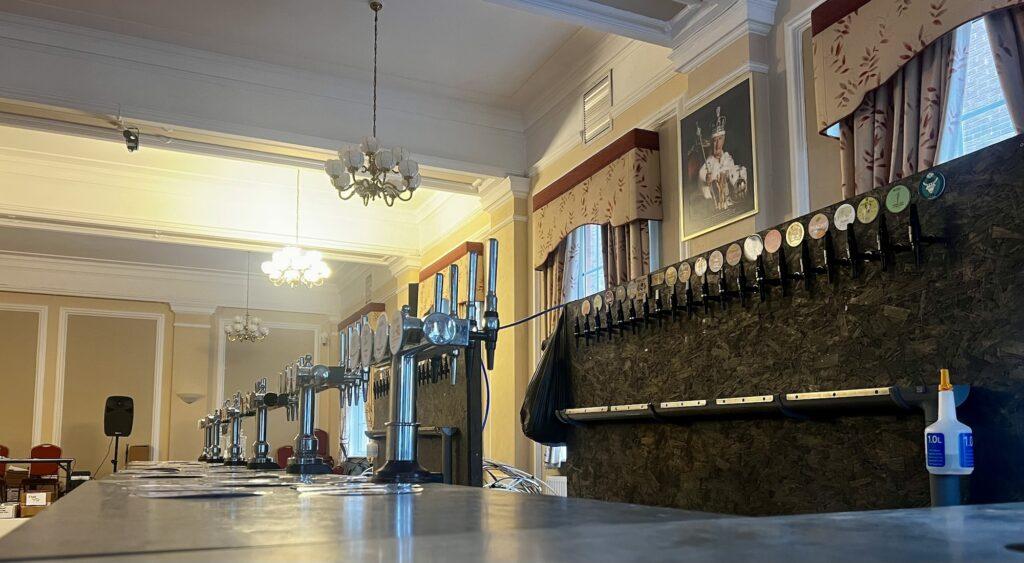
Parked up and settled, I joined the #ISBF Family (it’s close knit, that’s for sure!), and we put the finishing touches on the bars, labelling up the tap wall and bar taps.

With almost everything under control or completed, it was time for a cuppa (“Builders Tea” for me) before the session, and the Festival officially started at 6pm.

I now probably know about 20+ great people purely because of being a part of the #ISBF Family. I may tell you a little bit about a few of them over the next day or so, as there are a fair few without which, I doubt this shebang would happen.

Jim Cullen, the founder/organiser/puppet master/beer assembler extraordinaire!

Since the first and every year since, this begins to happen because of him. He has a drive to raise money for a Charity close to his heart, START Inspiring Minds’. It’s a charity that has been delivering mental health recovery and prevention services in Salford for over 30 years. It’s personal for Jim.

He also has a passion for finding the best beers from the best breweries. The passion and personality of Jim have formed this assembly of people who are friendly, kind & relaxed. To be clear I don’t just mean the volunteers (“The Family”), but also the punters, a significant proportion of come year after year.

It really is something quite special.

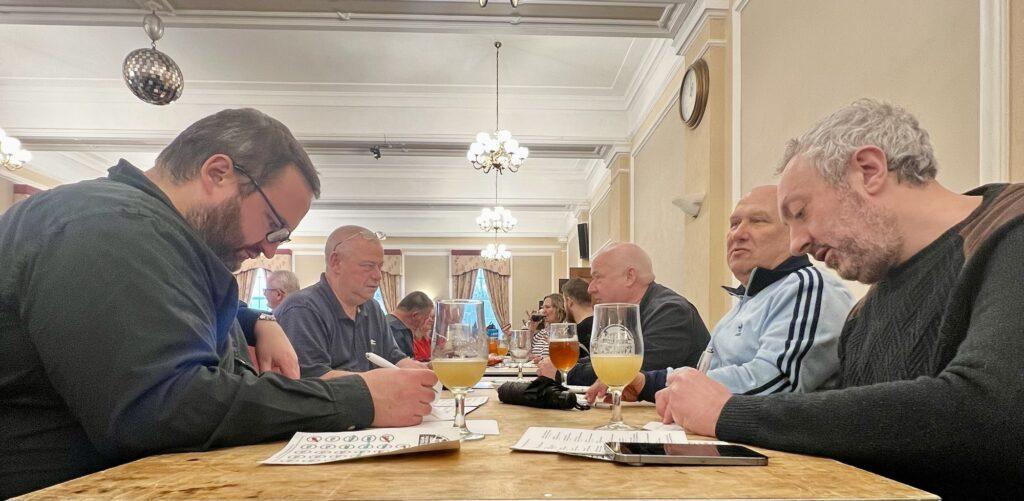
From 6pm onwards, I was one of those punters. I got my glass, my pen, my programme and my £10 worth of tokens and headed in to the Keg Bar.

Unsurprisingly, within minutes, I had met a few familiar faces and sat with a few friends I’d met through BrewClub a cracker of a pub in Stockport called The Petersgate Tap, and on a Brewday up at Torrside, New Mills.

My first beer was 1/3 of a pint of a 3.7% West Coast IPA, and the second was a 3rd of a Blood Orange & Nettle Barrel Aged Sour.

Third was another 3rd of an Apple & Rhubarb Sour, followed by a 3rd of a Biere De Saison Sour made with Morello Cherries.

Spotted some patterns? No pints and lots of sours so far!

The beer sponsor for this one is a bit of a nob apparently.

I’ll not bore on and list everything I tried, but over a 5 hour session I drank 7 beers that were amazing, all bar one in 3rds, along with sips of other people’s beers and they were all well worth trying.

So now I sit in my van, in the carpark writing this. Before I get my head down & ready myself for tomorrow, when I will help prep for the lunchtime session, before once again, and for the final time this weekend be a punter.

Beer Waffle – Part 2: The Road To Hemsley

So, the boring but relevant context is now over & I’m on a holiday of sorts so let’s change the mood!

I spent part of this Tuesday driving to Salford & helping some folks lug beer kegs, pins and glasses around while some other folk built a makeshift mega-pub that will serve 60 keg and 23 cask beers, all of which won’t have ever been served in Manchester (some, anywhere) before. All brewed by amazing breweries. It’s ludicrous to try and do that! 

This is #ISBFX – Independent Salford Beer Festival 10, the twelfth time this has been held in some form or other, I think. Yep, I know – 12 or 10? 

Anyway, it was an eventful day!

I got up, but as I was heading out, I poured my usual many espressos (using coffee imported from Colombia by a nice bloke in Stockport who runs a cracking cafe, and that may feature in a later blog) into a travel mug, headed out to my ‘Van and set off.

A quick nip into my workplace to buy some work gloves because I have cuts and bruises on my hands from ‘tinkering with vehicles’, a splash and dash of diesel and then off to Salford Crescent.

Somewhere near the end of the A34 two things happened – my clutch pedal went ‘weird’ and as I took a swig of a quad of double espressos (I did say I drank a lot of coffee), the top of the cup burst, and I got covered in expensive Colombian product. Thankfully, not scalding hot (or white!).

By the time I got to the A57M, the clutch pedal was almost redundant with little resistance. By Hemsley House on Salford Crescent, my destination, it was sat on the floor. Ay well! Jim (the Head Honcho in the ISBF Family) had ok’d it with the venue that I could camp out for the event. It may just need to be a tad longer than anticipated!

So how come I’ve ended up being a volunteer, a Beer Sponsor and (as of a few weeks ago) even involved in the brewing of one of the beers at this year’s event? For that we need to go back in time…

I mentioned in the last blog that I met up with an old school friend and some of his mates. I was walking past what used to be a Merc showroom near the Etihad back in 2017, saw Noz & we said hello. We chatted and I ended up having a found that they have a passion for “good beer”. 

In fact, between Noz and Dan they don’t just know about good beer, but they also know a lot about Manchester pubs and their history (well worth clicking on the link, btw). So much so that they had written up what I believe is something that was a “before its time” level of underrated brilliance. A pub guide that was honest and useful. Check out the articles that are numbered 001-205 as they visited them all! It must have been a right chore!

We arranged to meet up again after a game or something along those lines and my hazy recollection is that somehow on a cold and wet early Spring night in March 2018, we ended up huddling around electric bar fires  in a damp-smelling railway arch under Piccadilly Station tracks in the original Cloudwater Brewery, drinking beers with styles I was only just starting to understand – NEIPA, TIPA, DIPA, DDH IPAs (lots of IPAs it turned out!).

This was the relatively early stage of Manchester becoming one of the most influential Cities as far as ‘Craft Beer’ was concerned, albeit a lot of the breweries had been around a while. This was a time when Alphabet, Blackjack, Cloudwater, Marble, Track et al were growing and leading a drive forward for good beer, made with care & quality ingredients, rather than meeting taxation thresholds and duty brackets and stifling any potential competition from start-ups.

It turns out that Noz, Dan and a few of the others had been to a beer festival and got to know Jim (the aforementioned organizer) of Independent Salford Beer Festival. He was running the festival again and this time he was moving it to a bigger, better venue – Hemsley House on Salford Crescent. As soon as we all could, we bought tickets for the Saturday evening and that was when my love affair truly began!

At the Independent Salford Beer Festival 5 – “Revenge Of the Fifth!”.

We all went into town early and headed to the Etihad to watch Manchester City play and beat AFC Bournemouth (3-1 Final Score, Bernardo Silva – 16′, Raheem Sterling – 57′, Ilkay Gündogan – 79′ and for AFCB, Callum Wilson – 44′) before sneaking off a touch early and assembling nearer the centre of town so we could all get taxis to Salford. We then reassembled in Bexley Square at The New Oxford pub, had a pint and began the short walk west down Chapel Street onto the Crescent.

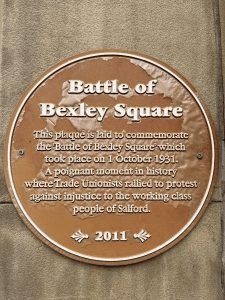
One of the many superb folks that were part of the very eclectic group, Vinny, provided me with a genuinely interesting and also very entertaining history of the parts of Salford that we passed, starting with the 1931 “Battle of Bexley Square,” a violent clash between police and 10,000 unemployed protesters demonstrating against the means test, and also the now dilapidated The Crescent pub, the location where Marx and Engels are thought to have met and discussed ideas for works like the Communist Manifesto. He made it more entertaining than that, though!

We presented tickets and were welcomed into Hemsley by Jim & the team. We picked up our glasses, programme and sheet of tokens and found a cracking table for us all to settle at. You head to the bar, where beers are in alphabetic brewery order (Amity Brewing will be to the left and Wander Beyond will be to the right-hand end of the bar).

I have no idea now what I had to drink but I know that the quality of beer and the friendliness of the team of volunteers made it special. So special that it became evident very quickly that even the attendees seemed to be like-minded and friendly, even at the end of a long session of supping. And it was all for charity!

The only negative was that I put my glass down on the doorstep to unlock it when I got home and heard a ‘clink’ sound. It was in pieces.

So tomorrow, I will head back to Hemsley, hopefully without issues with the campervan clutch pedal (there inevitably will be, so watch this space), help set up for the first session and then meet up with a load of familiar faces who will be regular attendees at an ISBF bash, and try some incredible beers – one of which I mashed in!

But that’s for tomorrow!

Beer Waffle – Part 1: Me, Alcohol & Beer.

I have an urge to “waffle in type” or “type waffle”. It’s the readers prerogative to decide their view so read on with that in mind.

This is about my relationship with beer. First thing to note is that it’s a different thing to my relationship with alcohol, but inevitably those paths will cross.

A lot of friends would probably say “oh yeah, he’s a big drinker”. I have never smoked, vaped, or ‘done’ any drugs and I know I won’t ever, I don’t often drink spirits and I do drink lots of coffee and am on Lisinopril for blood pressure. And whether right or wrong, I do know I drink more beer by units than I’m supposed to.

The reason why I differentiate between alcohol and beer is that they “do” different things for me.

So let’s clear the first and the one that is easier to chat about. My relationship with alcohol is quite one dimensional and basically I wholeheartedly, and without any pressure, confess that I use alcohol to help me sleep because for much of my last years I’ve struggled to turn my head off at night and so my sleep has been terrible.

The original, and my attempt.

I have used a mindfulness app (Headspace) for the last 11 or 12 years and it makes a big difference, of course it does, but sometimes especially when I was working in a more corporate environment it wasn’t enough.

Since changing my career “and working more casual roles” rather than a corporate role, my mental health regarding sleep has been improved significantly. But my head still races with thoughts and ideas and enthusiasm long after I really wanted to when I’m tired. So I still “self medicate”, apparently the term of choice.

It’s actually about that simple but it’s not a distinction that some people would make because I do love almost everything* about beer!

Just to be clear (and this is something that most people that know me would acknowledge is) it’s about the only thing I do drink so it’s a volume product. And by the way, when I can be bothered, I might decide to have a night off, maybe even two or three, but that will depend on how I’m sleeping.

Outdated, but credit to https://www.themadfermentationist.com/ for the graphic

*I dont like the way non-macro breweries are restricted, not encouraged, when the multinational corporations duck taxes and duty. 

Here’s a bit after all that boring contextual intro that I really want to talk about and it’s my relationship with beer.

Beer is a fermented product that is generally considered to contain only four ingredients – water, malt, hops & yeast.

I grew up drinking exactly what you expect in terms of beer which was crap lager interspersed with the odd macro produced cream flow Boddies, which I eventually got sick of drinking. I tried drinking wine and I now definitely know what wine I like (and it’s massive Tuscan “smash-you-around-the-head”, bold juicy knockout wines).

That is definitely not something that’s sustainable so I started to move back to drinking the same old crap that I was used to drinking. 

Then there was an epiphany in so much as myself, my mate Gary and Ian went to a local beer and wine festival where I tried a beer from a brewery called Thornbridge called Jaipur which was a at the time classically brewed East India Pale Ale. I bloody loved it! I had some other beers that night, some of which were more well known & accepted tastes, like Guinness. I didn’t enjoy them as much as I enjoyed Jaipur.

A WCIPA (West Coast IPA) beer I got to brew belatedly for my 50th with Made Of Stone Brewery in Bramhall called Cable Tied. Thanks to Andrew for the opportunity!

I remember that I was amazed that you could make such different beers using four basic ingredients. So here’s the wormhole moment.

I openly describe myself as a compulsively obsessive obsessive compulsive and I think my parents would have agreed to that description as I was growing up. 

Because of this I needed to know more about how those things could be made to be so different with such simple ingredients. Then one evening, coming home from a Manchester City home game I bumped into an old school friend, Noz, who I’ve known since I was four years old who was with his mates.

They were very welcoming and we ended up going to visit a few brewery tap rooms that had set up under the arches in Manchester along Sheffield Street. My mind was blown! I enjoyed the company, the environment, the product and the fact it made me question even more. How on earth you could make so many different beers from so few ingredients. 

From that point on it was inevitable that I was going to have a go at home brewing a beer because I’m one of those people we’re doing something is the best way I learn.

The gateway beer.

I did a small bit of research and bought a very very simple bucket brew kit that came with a kit of beer and some basic instructions and I gave it a go. It was a kit and the beer was a kit as well. I put a bag of something into some hot water and then put that syrup into some more hot water. The beer wasn’t very good and I learned nothing about what made be different from the four ingredients.  

And that’s when, me being me, I moved up and began what is known as “all grain” brewing where you pick the specific varieties of grain, you choose the specific hops for that beer, and you decide on a yeast that fits that type of beer. And that’s put in simple terms, as I now know!

With the help of many people, some of whom are from the Chiverton Tap Homebrew Club, some of whom are professional breweries who I have had the absolute honour of brewing with, such as Andrew from The Mounting Stone in Bramhall, Toby from Redwillow in Macclesfield, all the folks at Torrside up in New Mills, and latterly Mark and his team at Runaway Brewery in Stockport, I have learned a lot!

Whilst I am no expert, I now have a good grasp on why you can make a Guinness or a Grisette from the same four basic ingredients: water, malt, hops and yeast.

I sort of apologise for the long intro. But then again. 

If you’ve got this far, then the next blog or two might be of interest because I then went to the best beer festival in the world, and the next bits aren’t about the beer as much as you might think…